


LÆR ALT OM
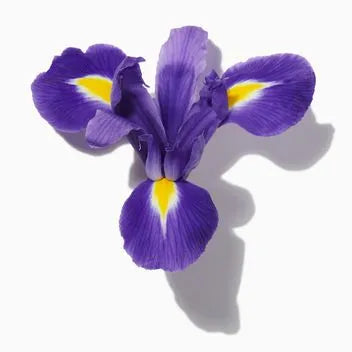
Iris
Iris
Bedst i selskab med viol eller berusende mimose er iris en lidt diskret, blød og sensuel note. Den er reserveret til de fineste akkorder, parfumeriet har at byde på, og er berømt for sin stejle prisseddel. Faktisk kan iris meget vel være den dyreste ingrediens i en parfumørs arsenal. Og med god grund: dens blomstrede, pudrede facetter giver dufte en uovertruffen elegance og lethed.
Iris fylder en duft med smuk melankoli - dens "våde fortov i regnen"-aroma tilfører blomsterparfumer en følelse af nostalgi og dybde. Aromaen minder om violer, blot ikke så sød - den er fyldig, pudret og frodig med en let mineralsk/metallisk accent. Iris er bedst i tilbageholdne, eftertænksomme blomsterdufte, hvor dens fortryllende intimitet får selskab af viol, pæon, rose, jasmin og bløde krydrede noter.
Træagtig-grøn, pudret, blød, blomstret, raffineret, beslægtet med viol, varm og holdbar.
GreeceItalyMoroccoIndiaFloral
Historie
The iris has a rich history throughout different cultures. In Greek mythology, Iris was the messenger to the Gods, most notably to Hera, Zeus' wife, who adored Iris for always bringing her good news. Iris took the form of a graceful young girl embellished with brightly colored wings displaying the colors of the rainbow. To mortals, she actually appeared in the form of a rainbow as she delivered them their divine messages. It is Iris' association with rainbows that earned them the poetic nickname Scarf of Iris. The iris flower itself played a role in Egyptian mythology as it was linked to the gods Osiris and Horus. There is even an iris engraved into the foreheads of the Egyptian sphinxes to represent Horus.
Produktion
Though native to the Far East, iris is predominately grown in Italy and Morocco today. Absolute iris comes from a volatile solvent extraction of crushed roots. This process starts after three years of growth, when the roots are peeled, washed and dried in the sun or an oven at a moderate temperature, while the rhizomes are processed all year, dried in an oven at 40-degrees for two years. They take on a violet scent thanks to ketones called irones. In the next step, they are crushed and steam-distilled to create iris butter, sometimes also referred to as concrete. With such a lengthy, complicated extraction process and low-yield, the high prices are understandable, with the Iris Padilla variety fetching more than 100,000 euros-per-kilogram! The yield of crushed rhizomes accounts for 0.2-0.4%. Absolute is created when the fatty acids are eliminated through the purification process.
Vidste du?
Powdered rhizomes are used both in talcum powder and face powders. The iris derives its rich scent from containing a large quantity of irones, the scent of violet. This fragrance is said to have a positive effect on behavior. The flower's petals change texture and shimmer, thus inspiring the word iridescent.
