


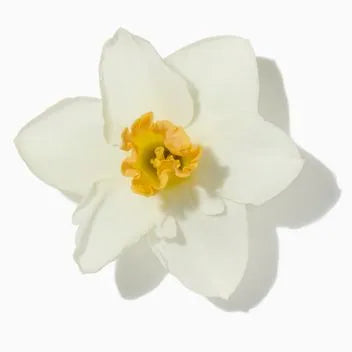
LÆR ALT OM
Narcissus
Vildt fortryllende og evigt narkotisk - narcissens duft er berømt med god grund. Dens berusende, honningagtige facetter er på én gang animalske og søde. Fyldige, blomstrede toner smelter sammen med frugtige, grønne facetter: foråret omsat til en flydende form.
Blomstret, grøn, frugtig, animalsk, honningsød, vild og berusende.
France
Historie
In Greek mythology, Narcissus was so absorbed in his own beauty that he ignored his young admirers. One of the women, Echo, was so hurt by being ignored that she gradually disappeared until only her voice could be heard. The gods were so angry they condemned Narcissus to fall in love with his own reflection in the water. When he died, he was transformed into a daffodil.
Produktion
From late May until mid-June, the narcissus poeticus punctuates the fields of the Aubrac plateau of France with its small white flowers. Interestingly, narcissus is the only wild-growing flower still used in perfumery, with most of its production coming from France, and just a small amount produced in Morocco and Egypt. The white flowers were picked by hand until the 1970s when a 30 cm wide comb was designed to pluck flowers without damaging the petals. This comb evolved into a manual mechanical machine which meant the flowers were harvested by pushing a wheeled comb through the fields. In 2012, Laboratoire Monique Rémy developed a harvesting machine that allows the flowers to be picked 30 times faster. This means that some of the flowers picked are less mature, which creates a fragrance that is more authentic to how the flower smells in nature. Narcissus absolute is obtained through extraction with volatile solvents and then washed with alcohol. 1000 kg of flowers are needed to produce only 2 kg of concrete which can be turned into 750 g of absolute.
Vidste du?
800,000 flowers are used to create just 1 kg of precious absolute. There are 22 varieties of narcissus. Narcissus Tazetta used to be the predominant variety used in perfumery, but today it is mostly the poet's narcissus. Its scent soothes nerves and engages subtle wit. Thanks to its origins in Greek mythology, the flower symbolizes egotism.
